Return to Hobie.com
Hobie Forums
It is currently Mon May 18, 2026 8:11 pm

All times are UTC - 8 hours [ DST ]


Post new topic Reply to topic  [ 36 posts ]  Go to page Previous  1, 2, 3
Author Message
PostPosted: Wed Aug 28, 2024 2:50 pm 
Offline
Site Rank - Admiral

Joined: Wed Jun 24, 2015 6:38 pm
Posts: 225
Location: Pennsylvania - Philly Area
Another review of the Torqeedo....

https://youtu.be/FN8P_zhPk78?si=of5VsxhhLIQOvDmQ

_________________
Jim
Hobie TI 2022 - Offshore rig - Outboard - having fun!
Hobie TI 2021 - Offshore rig - Outboard - sold
Hobie TI 2016 - Offshore rig - Outboard - sold
Hobie Kona 2014
Hobie AI 2015 - sold
Hobie Rev 13 2014 - sold
Hobie Outback - 2008 - sold


Top
 Profile  
 
PostPosted: Fri May 30, 2025 7:18 pm 
Offline
Site Rank - Admiral

Joined: Wed Jun 24, 2015 6:38 pm
Posts: 225
Location: Pennsylvania - Philly Area
Electric Outboards continue to improve.

Here is a short Youtube video that gives you an overview.

https://youtu.be/zcUkVTuxeEU?si=9rbpZD_jMnnYu45Z

As for my sailing needs in coastal, tidal, current driven, waves and longer distances..... I am still rocking my Suzuki 2.5 hp outboard. I consider this small gas outboard my lifejacket for my TI.

_________________
Jim
Hobie TI 2022 - Offshore rig - Outboard - having fun!
Hobie TI 2021 - Offshore rig - Outboard - sold
Hobie TI 2016 - Offshore rig - Outboard - sold
Hobie Kona 2014
Hobie AI 2015 - sold
Hobie Rev 13 2014 - sold
Hobie Outback - 2008 - sold


Top
 Profile  
 
PostPosted: Sun Jan 11, 2026 11:00 am 
Offline
Site Rank - Deck Hand

Joined: Sun Jan 11, 2026 12:53 am
Posts: 2
This experience and knowledge here has been extremely helpful for me in the effort of motorizing my TI, big thanks for that. The motor that I eventually chose, the Torqeedo Travel Ultralight (succesor of 1103AC) was not availlable when this thread was started, so I want to share some of my experience with it to help others.
I decided on the Torqeedo Travel Ultralight because it meets the following requirements:

1) Has an app that displays the remaining range as a circle.

2) Has the highest possible solar charging capability in this class.

3) Has a maximum power output of 1.1 kW.

Point 1) was particularly important to me because I have a very impatient wife as a passenger. For that reason, for longer trips I precisely adjust the motor power so that the destination on the map is just barely still inside the circle displayed in the app. For the return trip, I use the same approach with a second battery. Thanks to the app, I can fully utilize both batteries, have the maximimum speed for that distance and don't have to be afraid of unpredictable factors such as changes in solar radiation, headwinds, and current, which are automatically taken into account and factored into the range calculation.

Point 2) was important for me because I often leave my boat moored to a buoy for several days and do not want to have to take the batteries ashore for charging. The solar charging capability of the Travel Ultralight has improved significantly compared to the 1103 AC. While the 1103 AC was limited to a maximum of 115 W, the batteries of the Travel Ultralight can be charged with up to 200 W. I can also confirm 190 W in practice.

Point 3 was important to me for insurance-related reasons, because Hobie specifies a power rating of 1.1 kW.

I was initially unsure whether, for reasons of flexibility, I should choose the transom version of the 1,1kW Torqeedo instead of the kayak version, but I decided against it because it was more expensive, I would have had to purchase an additional throttle and because there is currently no extension cable set available to place the battery inside the boat. If I had to choose now, the decision would be harder as Torqeedo recently released a cheaper 700W transom version of the motor (called smart package). This 700 W Torqeedo produces less than 55 lbs of thrust, which means that with this motor instead of having to build a custum motor mount it would also be possible to use the commercial motor mounts from Railblaza (rated for a maximum thrust of 60 lbs) or Island Hopper (rated for a maximum thrust of 55 lbs). However, everyone has to decide for themselves whether top speed or ease of installation is the higher priority. In any case, I am very satisfied with my 1.1 kW Travel Ultralight.

At first, I also considered choosing the Spirit Evo because of its unique hydro-generation capability. However, due to the less durable Li-Po cells instead of Li-Ion cells, as well as the lack of an app (and the absence of GPS), I ultimately decided on the Torqeedo instead. The best part: although it is not advertised for some reason, the Travel Ultralight can also perform hydro-generation. The highest output I have seen so far was 40 W, but it was completely calm, and achieving 40 W charge for a few seconds really required pedaling like crazy. I don't know yet how useful this feature is under sail, but it is just nice to have it.

Finally, one more aspect regarding solar charging: To realistically achieve the maximum solar charging power of 200 W, you need a panel with at least 300 Wp. The challenge is that, to reach those 200 W, the panel’s Vmp has to be between 35–45 V. At the same time, the Voc must not exceed 49 V. I specifically confirmed this with customer support. It was not easy to find a module that met these criteria. Because semi-flexible crystalline solar panels tend to develop microcracks over time due to bending, I opted (despite slightly lower efficiency of 17% vs. 23%) for a rollable 320 Wp CIGS solar panel with a Vmp of 38.6 V and a Voc of 48.3 V, and so far I am very satisfied with it. I am even considering purchasing a second panel for my second battery next season. At that point, however, almost the entire surface of the boat would be covered with solar panels. With two 320 Wp modules, I could theoretically cruise at 400 W without discharging the batteries, but I would have to keep switching the motor back and forth between the batteries while underway so that neither battery becomes fully empty nor fully charged, but instead remains in the SOC range where the 200 W charging power is achieved. We’ll see, perhaps I can report back after next season.


Top
 Profile  
 
PostPosted: Fri Jan 23, 2026 1:40 pm 
Offline
Site Rank - Deck Hand

Joined: Mon May 13, 2024 8:43 am
Posts: 14
SolarIsland wrote:
This experience and knowledge here has been extremely helpful for me in the effort of motorizing my TI, big thanks for that. The motor that I eventually chose, the Torqeedo Travel Ultralight (succesor of 1103AC) was not availlable when this thread was started, so I want to share some of my experience with it to help others.
I decided on the Torqeedo Travel Ultralight because it meets the following requirements:

1) Has an app that displays the remaining range as a circle.

2) Has the highest possible solar charging capability in this class.

3) Has a maximum power output of 1.1 kW.

Point 1) was particularly important to me because I have a very impatient wife as a passenger. For that reason, for longer trips I precisely adjust the motor power so that the destination on the map is just barely still inside the circle displayed in the app. For the return trip, I use the same approach with a second battery. Thanks to the app, I can fully utilize both batteries, have the maximimum speed for that distance and don't have to be afraid of unpredictable factors such as changes in solar radiation, headwinds, and current, which are automatically taken into account and factored into the range calculation.

Point 2) was important for me because I often leave my boat moored to a buoy for several days and do not want to have to take the batteries ashore for charging. The solar charging capability of the Travel Ultralight has improved significantly compared to the 1103 AC. While the 1103 AC was limited to a maximum of 115 W, the batteries of the Travel Ultralight can be charged with up to 200 W. I can also confirm 190 W in practice.

Point 3 was important to me for insurance-related reasons, because Hobie specifies a power rating of 1.1 kW.

I was initially unsure whether, for reasons of flexibility, I should choose the transom version of the 1,1kW Torqeedo instead of the kayak version, but I decided against it because it was more expensive, I would have had to purchase an additional throttle and because there is currently no extension cable set available to place the battery inside the boat. If I had to choose now, the decision would be harder as Torqeedo recently released a cheaper 700W transom version of the motor (called smart package). This 700 W Torqeedo produces less than 55 lbs of thrust, which means that with this motor instead of having to build a custum motor mount it would also be possible to use the commercial motor mounts from Railblaza (rated for a maximum thrust of 60 lbs) or Island Hopper (rated for a maximum thrust of 55 lbs). However, everyone has to decide for themselves whether top speed or ease of installation is the higher priority. In any case, I am very satisfied with my 1.1 kW Travel Ultralight.

At first, I also considered choosing the Spirit Evo because of its unique hydro-generation capability. However, due to the less durable Li-Po cells instead of Li-Ion cells, as well as the lack of an app (and the absence of GPS), I ultimately decided on the Torqeedo instead. The best part: although it is not advertised for some reason, the Travel Ultralight can also perform hydro-generation. The highest output I have seen so far was 40 W, but it was completely calm, and achieving 40 W charge for a few seconds really required pedaling like crazy. I don't know yet how useful this feature is under sail, but it is just nice to have it.

Finally, one more aspect regarding solar charging: To realistically achieve the maximum solar charging power of 200 W, you need a panel with at least 300 Wp. The challenge is that, to reach those 200 W, the panel’s Vmp has to be between 35–45 V. At the same time, the Voc must not exceed 49 V. I specifically confirmed this with customer support. It was not easy to find a module that met these criteria. Because semi-flexible crystalline solar panels tend to develop microcracks over time due to bending, I opted (despite slightly lower efficiency of 17% vs. 23%) for a rollable 320 Wp CIGS solar panel with a Vmp of 38.6 V and a Voc of 48.3 V, and so far I am very satisfied with it. I am even considering purchasing a second panel for my second battery next season. At that point, however, almost the entire surface of the boat would be covered with solar panels. With two 320 Wp modules, I could theoretically cruise at 400 W without discharging the batteries, but I would have to keep switching the motor back and forth between the batteries while underway so that neither battery becomes fully empty nor fully charged, but instead remains in the SOC range where the 200 W charging power is achieved. We’ll see, perhaps I can report back after next season.


Thank you for the great feedback!
Do you have a link to the solar panel that worked for you? Appreciate any further info you can share.

Brad


Top
 Profile  
 
PostPosted: Sun Jan 25, 2026 11:54 am 
Offline
Site Rank - Deck Hand

Joined: Sun Jan 11, 2026 12:53 am
Posts: 2
kowbra wrote:

Thank you for the great feedback!
Do you have a link to the solar panel that worked for you? Appreciate any further info you can share.

Brad


Hi Brad,
Here: The eBay listing (https://www.ebay.com/itm/335609495284) only ships to Europe, but this Alibaba link (https://www.alibaba.com/product-detail/ ... 46372.html) features the same model (W36-320) with identical specs and worldwide shipping.
On a sunny day, this panel provides the energy equivalent of a fully charged Torqeedo battery—at half the price and half the weight. However, keep in mind that while it only weighs 4kg, its dimensions (1.7m x 1.3m) are substantial. It won’t fit on a single Ama; if you try the overhang would likely bend and touch the water. If you don't have a front passenger, you can center it across the main hull and parts of the Amas, which works well.
I previously mounted mine on a bimini, similar to what mswlogo showed here (https://www.hobie.com/forums/viewtopic.php?f=71&t=61433). Having both shade and power is a great combination, but you can’t sail with an open bimini, and stowing it on the water with the solar panel attached is difficult.
Next summer, I plan to test mounting it in front of the Amas, similar to what is shown in this video (https://www.youtube.com/watch?v=B34_bJtdRE4). This is ideal for sailing. But the risk there is wave exposure; in that video, the brittle crystaline modules were destroyed by a single wave. Even with a flexible CIGS module, I’m cautious. A higher mount or a rigid support (like a SUP) might work, though that adds significant weight.
My most ambitious plan is to mount it over the rear seat using an H-bar, inspired by this build (https://www.youtube.com/watch?v=VIYjfQeVRXk). This would allow for sailing, shade, and power simultaneously, though I’m not too optimistic that it's feasible with a panel as large as 1.7m x 1.3m.
I hope that helps. If you find a better way to mount the panel, let me know.


Top
 Profile  
 
PostPosted: Sat May 09, 2026 1:15 pm 
Offline
Site Rank - Deck Hand

Joined: Wed Sep 18, 2024 4:12 pm
Posts: 1
I have come across an interesting issue when using your A-Series Motor Mount on a Hobie Mirage Adventure Island (AI). This is the single person version and NOT the Hobie Tandem Island.

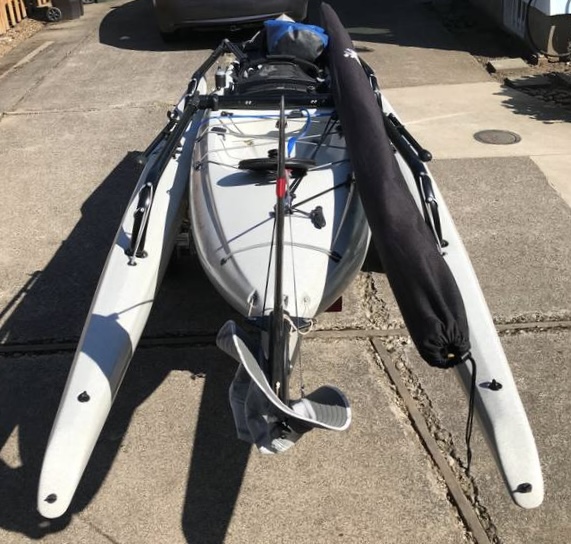
On the Adventure Island (AI) the aft most deck-mounted crossbar is actually behind the cockpit seat. As a result and crucially when the Adventure Island (AI) is in the folded position for trailering the Aka folds right in the way of the motor mount. This is different than the Tandem Island which has the crossbar in front of the rear cockpit seat and the folded Aka is fore of the motor mount.

Image

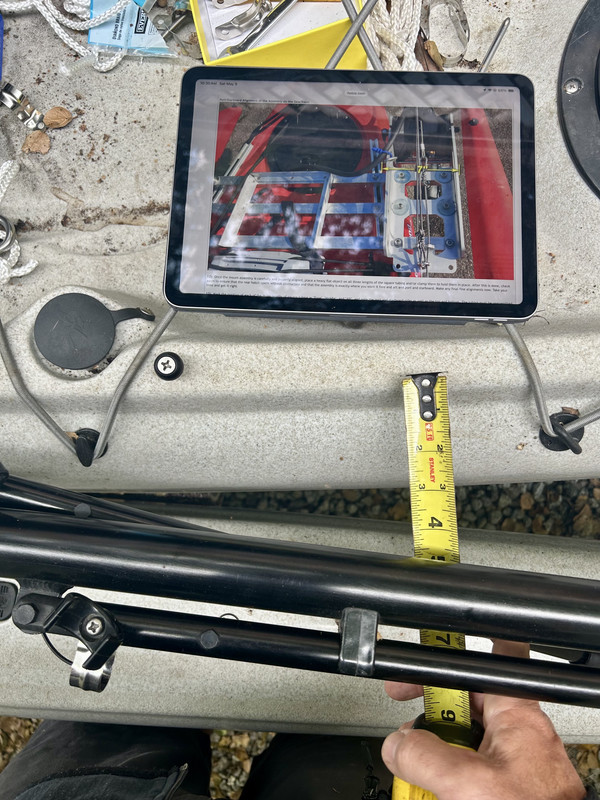
From your instructions the port end of the A-Series bracket needs to be approximately 7 inches from the port side of the GearTrac where the square tubing contacts it aftmost. From my measurements on the Adventure Island (AI) that distance with the folded Aka is only 4.5 inches.

Image

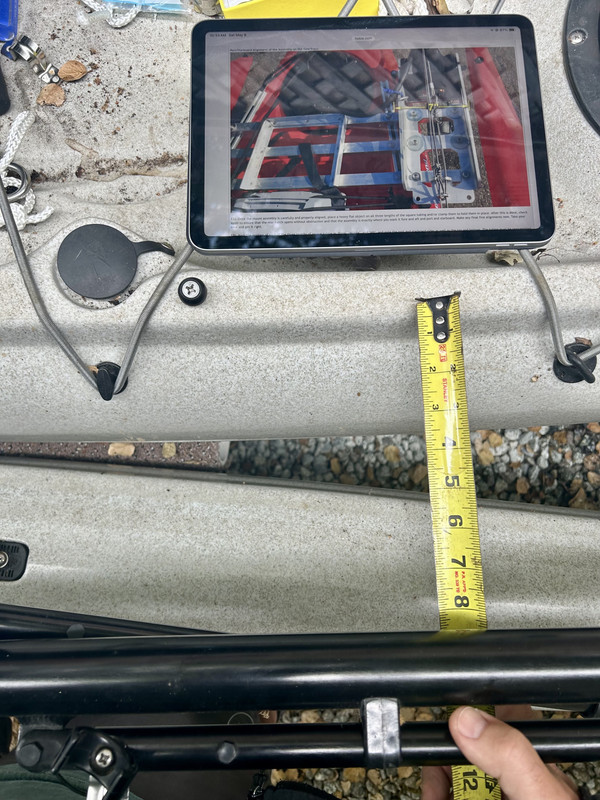
The solution I am thinking to do when trailering is to just depress the spring-loaded buttons on the deck-mounted crossbar and slide the aka out. This allows the Aka to be moved further to port and out of way of the motor mount. Detaching the Aka would provide at least 8.5 inches or more clearance.

Image

There have been some posts about the Aka popping out of the deck-mounted crossbar on its own. With the frequent detaching of the Aka it would be well advised to install backup "keep-out" lines that tie the Aka to the deck-mounted crossbar to prevent separation.


On a side note I am looking at the latest Torqeedo Travel Ultralight motor. Since it still uses the A-Series Motor Mount I am thinking your motor mount would work fine?
And the latest Travel Battery Ultralight could still sit in the Optional Battery Tray you mention in your instructions.

Thank you.


Top
 Profile  
 
Display posts from previous:  Sort by  
Post new topic Reply to topic  [ 36 posts ]  Go to page Previous  1, 2, 3

All times are UTC - 8 hours [ DST ]


Who is online

Users browsing this forum: No registered users and 2 guests


You cannot post new topics in this forum
You cannot reply to topics in this forum
You cannot edit your posts in this forum
You cannot delete your posts in this forum

Jump to:  
© Hobie Cat Company. All rights reserved.
Powered by phpBB® Forum Software © phpBB Group